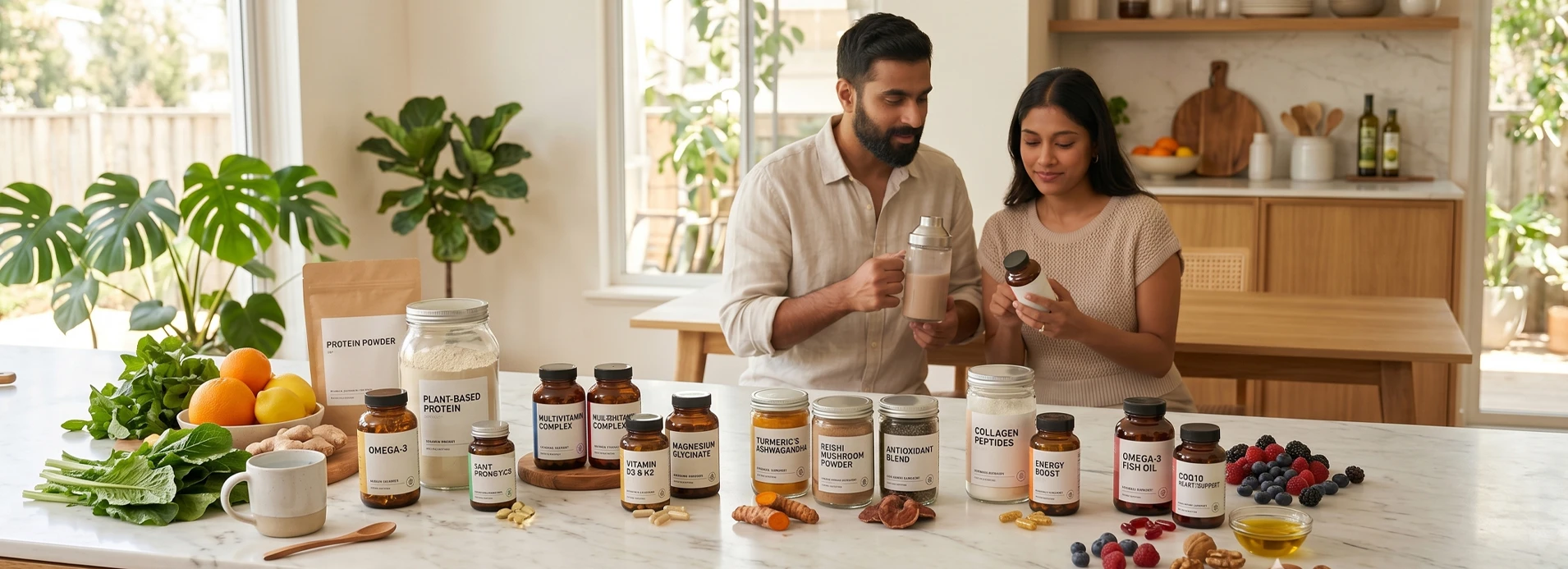
Reading a supplement label can feel harder than it should. A bottle may show grams, milligrams, micrograms, IU, %DV, ingredient forms, extracts, blends, and several other terms, all within a small space. The front of the pack may highlight one impressive-looking number, but that number may not tell you how much of the nutrient or active ingredient you are actually getting.
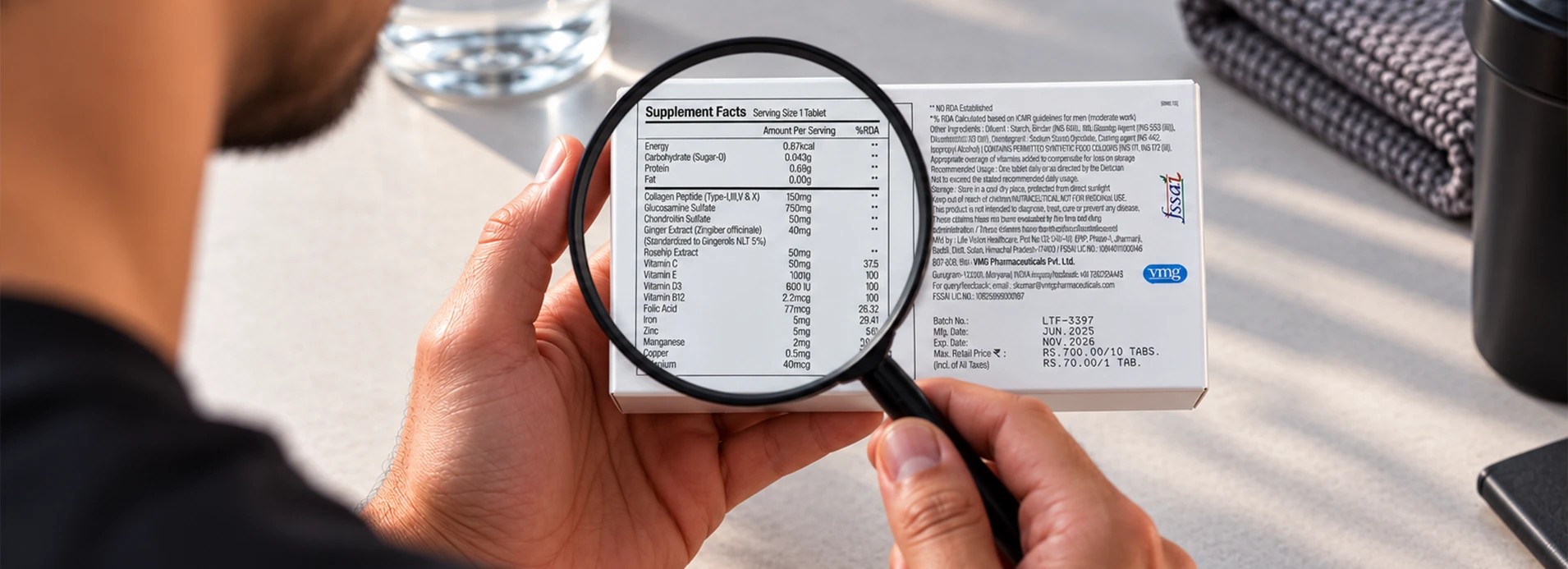
The Supplement Facts panel provides the information needed to understand a product more clearly. It typically identifies the serving size, servings per container, dietary ingredients, amounts per serving, and %DV where a Daily Value has been established. Other ingredients are listed separately.
Let’s understand some of the basics of understanding a supplement label.
Learn more about the heart health supplements
What Is a Supplement Facts Label?
| Label Term | What It Means |
| Serving Size | Amount represented as one serving |
| Servings Per Container | Approximate number of servings in the package |
| Amount Per Serving | Quantity of the listed ingredient in one serving |
| %DV | Contribution toward the established Daily Value |
| g | Gram |
| mg | Milligram |
| mcg | Microgram |
| IU | International Unit |
| DFE | Dietary Folate Equivalent |
| RAE | Retinol Activity Equivalent |
| NE | Niacin Equivalent |
| † / * | Usually points to a footnote, such as DV not established |
A Supplement Facts label is the section of a dietary supplement package that tells you what dietary ingredients the product provides and how much is present per serving. It may also show the percentage of the Daily Value for nutrients that have an established DV.
This panel is more useful for product comparison than the large claims printed on the front of the bottle. When you want to know whether a supplement actually provides the ingredient you are looking for, start here.
Supplement Facts vs Nutrition Facts
Nutrition Facts panels are used for conventional foods and beverages. Supplement Facts panels are used for dietary supplements.The two panels look similar because both communicate nutritional information, but they serve different purposes. A dietary supplement may contain vitamins, minerals, herbs, amino acids, and other dietary ingredients that are not presented in the same way as nutrients in conventional foods.
Read more : Joint support supplements
What Information Must You Look For?
When reading a supplement label, check:- Product identity
- Serving size
- Servings per container
- Dietary ingredients
- Amount per serving
- %DV where established
- Ingredient forms
- Other ingredients
- Directions for use
- Manufacturer or distributor information
- Warnings or cautions where applicable
Know more about the Best Omega 3 Supplements in India
Step 1: Check the Serving Size First
Serving size is the first number you should check because every amount listed in the Supplement Facts panel needs to be interpreted in relation to that serving.For example:
Product A Serving size: 1 capsule Magnesium: 200 mg
Product B Serving size: 2 capsules Magnesium: 250 mg
Looking only at 200 mg versus 250 mg can give you an incomplete comparison. You also need to know how many capsules provide that amount.
What Does “Serving Size” Mean?
Serving size tells you how much of the product represents one serving. Depending on the product, this could be one tablet, two capsules, one scoop, a packet, or another stated quantity.The listed amount of an ingredient generally corresponds to that serving. FDA guidance states that supplement labels must declare serving size and servings per container, with the serving size tied to the recommended amount under the labeling rules.
Serving Size vs Recommended Dosage
Serving size and your personal dosage are not always the same thing.The label may suggest a particular number of tablets or capsules per day, while individual requirements can vary based on age, diet, medications, health conditions, and professional advice. A healthcare professional may recommend a different intake where appropriate.
Why Serving Size Can Change Product Comparisons?
Two products can contain the same ingredient but use different serving sizes.For example:
- Product A: 1 capsule
- Product B: 2 capsules
- Product C: 1 scoop
- Product D: 5 g powder
- Product E: 10 g powder
Step 2: Understand “Amount Per Serving”
Amount per serving tells you how much of a listed dietary ingredient is supplied by the stated serving.This is one of the most important numbers on the label of the best nutrition supplement in India. If you are comparing magnesium supplements, for example, the declared magnesium amount matters more than simply counting the number of capsules in each bottle.
Compound Weight vs Active Nutrient Amount
This distinction is especially important with minerals.Suppose a product says:
Magnesium glycinate: 1,000 mg
That does not automatically mean the product supplies 1,000 mg of elemental magnesium. Magnesium glycinate is a compound containing magnesium and glycine. The amount of the compound and the amount of elemental magnesium are different measurements.
Therefore, look carefully at whether the label declares:
Magnesium — 200 mg or Magnesium glycinate — 1,000 mg
The first statement tells you the declared magnesium amount. The second describes the weight of the compound.
What Does “As” Mean on a Supplement Label?
You may see labels such as:- Magnesium (as magnesium glycinate)
- Zinc (as zinc citrate)
- Vitamin D (as cholecalciferol)
- Vitamin C (as ascorbic acid)
This distinction can help you compare products that contain the same nutrient in different forms.
Supplement Units Explained: g, mg, mcg, IU & More
Units tell you how much of an ingredient is present. Understanding them makes supplement comparisons much easier.What Does g Mean?
g stands for gram.One gram equals 1,000 milligrams.
For example:
2 g = 2,000 mg
Grams are commonly used when the quantity of an ingredient is relatively large.
What Does mg Mean?
mg stands for milligram.One milligram equals 1,000 micrograms.
For example:
500 mg = 500,000 mcg
What Does mcg Mean?
mcg stands for microgram.One microgram is one-thousandth of a milligram.
Therefore:
1 mcg = 0.001 mg
Small quantities of vitamins and minerals are often expressed in micrograms.
mg vs mcg: What’s the Difference?
The difference is substantial.- 1 mg = 1,000 mcg
- 0.5 mg = 500 mcg
- 250 mcg = 0.25 mg
- 100 mcg = 0.1 mg
What Does IU Mean?
IU means International Unit.IU measures biological activity rather than simply expressing an ingredient’s weight. The conversion between IU and mass depends on the specific nutrient or substance.
For that reason, there is no single universal conversion such as “1 IU always equals X mg.” The substance must be identified first.
What Are DFE, RAE, and NE?
Some nutrients use specialized units.DFE means Dietary Folate Equivalents.
RAE means Retinol Activity Equivalents and is used for vitamin A.
NE means Niacin Equivalents.
FDA’s current Daily Value reference information includes units such as mcg DFE, mcg RAE, mg NE and IU alongside standard g, mg and mcg measurements.
What Does %DV Mean on a Supplement Label?
%DV tells you how much a serving contributes to the established Daily Value for a nutrient.For example, if one serving provides 50% DV of a nutrient, that serving contributes 50% of the applicable Daily Value.
FDA describes %DV as the percentage of the Daily Value supplied by a serving.
Is 100% DV the Maximum Safe Amount?
No.Daily Value and an upper intake limit are different concepts. A DV is a reference amount used on labels. It should not automatically be interpreted as the maximum amount that can be consumed safely.
Safety limits can depend on the nutrient, total intake, age, health status and other factors.
What Does “Daily Value Not Established” Mean?
Not every dietary ingredient has an established Daily Value.When no DV exists, the label may use a symbol such as an asterisk or dagger that points to a statement such as:
Daily Value Not Established.
That does not mean the ingredient in a wellness supplement is unimportant. It means there is no established Daily Value against which the amount can be expressed as a percentage.
How to Compare Two Supplement Labels Correctly?
Use this seven-step framework.1. Compare Serving Size
Find out whether one product requires one capsule while another requires two.2. Compare Servings Per Container
A bottle with 60 capsules does not necessarily provide 60 servings.3. Compare Active Ingredient Amount
Look at the actual amount of the relevant nutrient or dietary ingredient per serving.4. Compare Ingredient Form
Check whether the nutrient is provided as glycinate, citrate, oxide, cholecalciferol or another form.5. Compare %DV
Where a DV exists, %DV provides useful context for the nutrient amount.6. Check Other Ingredients
Look beyond the headline ingredients and see what else is included.7. Compare Cost Per Serving
A simple calculation is:Cost per serving = Product price ÷ Number of servings
For ingredient-specific comparison:
Cost per 1,000 mg = Product price ÷ Total comparable active ingredient amount × 1,000
This calculation only makes sense when comparing the same ingredient and reasonably comparable forms and doses.
Recommended Read : Coenzyme q10 tablets India
Common Supplement Label Marketing Terms: What Do They Actually Tell You?
You may see terms such as:- High potency
- Advanced formula
- Premium
- Clinically studied
- Natural
- Plant-based
- Non-GMO
- Vegan
- Sugar-free
- Gluten-free
- Third-party tested
- Pharmaceutical grade
- Clean label
Marketing language is not the same as evidence of effectiveness.
A better process is:
Front-of-pack claim → Supplement Facts → ingredient amount → ingredient form → evidence → quality information
For example, a product marketed as daily multivitamin tablets should still be evaluated by checking the individual vitamins and minerals, their amounts, forms, and %DV rather than relying only on the product category.
Supplement Label Red Flags
Use this quick checklist when shopping:- Serving size is unclear
- Active ingredient amount is difficult to identify
- Proprietary blend hides individual quantities
- Compound weight is presented without enough context
- Front label makes extensive claims
- Manufacturer information is difficult to verify
- Directions are unclear
- Appropriate warnings are missing where relevant
- Ingredient names are difficult to understand or verify
- Product comparison is based only on capsule count
Supplement Label Myths vs Facts
| Myth | Fact |
| 100% DV means maximum safe intake | DV is a reference value, not automatically an upper limit |
| More mg means better | Dose must be interpreted in context based on dietary requirements, doctor’s advice and underlying medical conditions |
| One capsule equals one serving | Not necessarily |
| Fish oil mg equals EPA+DHA mg | Not necessarily |
| IU is the same as mg | No |
| Bigger %DV means better product | Not necessarily |
| Proprietary blend means higher quality | It does not establish quality |
| Natural means safer | “Natural” alone does not establish safety |
| More ingredients means better formula | Not necessarily |
| Front-label claims are enough | The Supplement Facts panel provides essential details |
How to Choose a Supplement After Reading the Label?
A practical decision framework is:Need → Ingredient → Form → Dose → Evidence → Quality → Cost → Suitability
Start with your reason for considering the supplement. Then identify the ingredient relevant to that goal.
Next, compare the form and declared amount. Check what evidence exists for that ingredient and consider the product’s quality information. Finally, look at cost and whether the product is appropriate for your individual situation.
This approach works across different categories, whether you are comparing magnesium supplement tablets, an omega-3 supplement, a multivitamin, or a collagen formula.
If you are comparing products marketed as the best collagen supplement in India, for example, the label should still be your starting point. Check the collagen amount, collagen source, serving size, and any additional ingredients before making a meaningful comparison.
Final Takeaway
Learning how to read a supplement label turns a confusing package into useful information. Start with serving size, then examine the actual amount per serving, units, ingredient forms, and %DV. Next, review proprietary blends, Other Ingredients, directions, and warnings.Most importantly, compare products using the information that tells you what you are actually getting, not just the number highlighted on the front of the package. A thoughtful label comparison can help you understand differences between products and make more informed supplement choices.
This article is for general educational purposes and does not replace personalised medical or nutritional advice. If you take medicines, have a medical condition, are pregnant or breastfeeding, or are considering high-dose supplementation, discuss supplement use with a qualified healthcare professional.