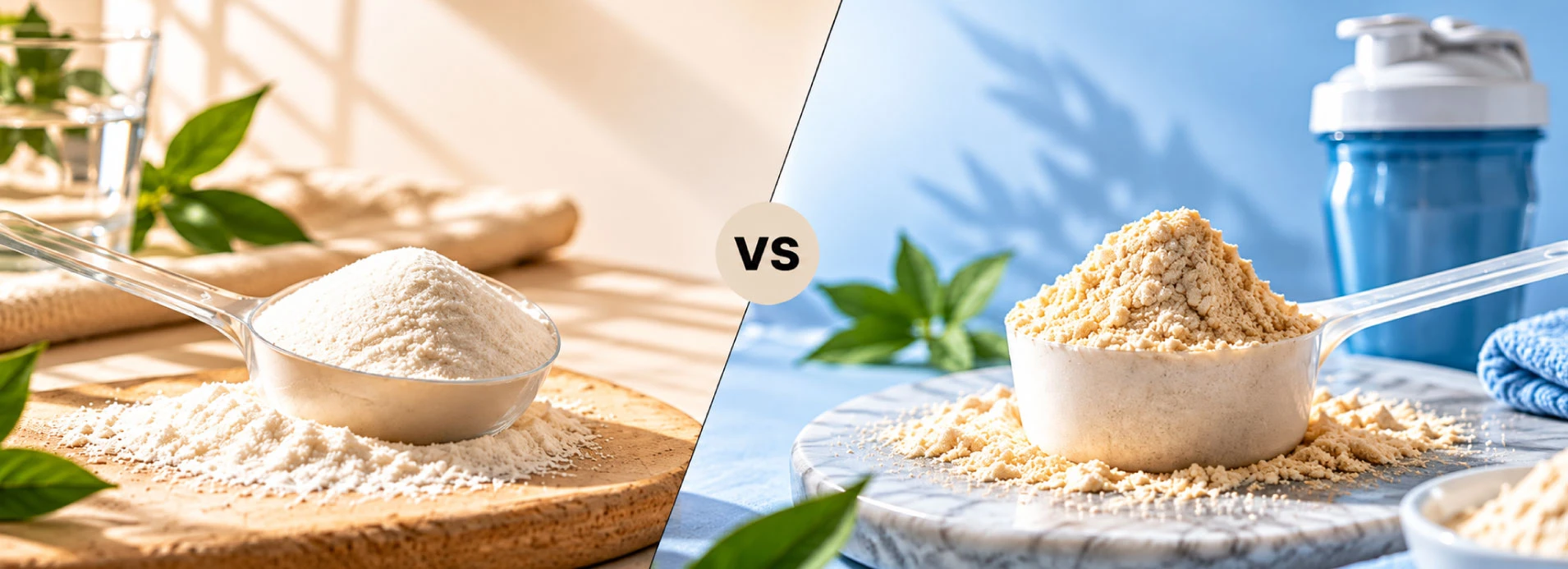
Collagen is one of the body’s most abundant structural proteins, supporting tissues such as skin, bones, cartilage, tendons and ligaments. With collagen supplements becoming increasingly popular, shoppers often encounter terms such as collagen protein, collagen peptides, and hydrolyzed collagen on product labels. These terms can make it difficult to understand what you are actually buying.
The good news is that the difference is easier to understand than it may seem. Collagen peptides are derived from collagen protein through hydrolysis, which breaks the larger protein into smaller peptide chains. Understanding this distinction, along with collagen source, dosage, formulation, and evidence, can help you make a more informed choice when selecting a collagen supplement.
Learn more about the Best Nutrition Supplements in India
What Is Collagen?
Collagen is a protein that provides structure and strength to many tissues throughout the body. It is particularly abundant in connective tissues, including skin, bones, cartilage, tendons, and ligaments.Unlike many dietary proteins that are primarily discussed in relation to muscle, collagen is particularly associated with connective tissue.
It contributes to the structural framework of:
- Skin
- Bones
- Cartilage
- Tendons
- Ligaments
- Other connective tissues
What does collagen do?
Collagen provides structural support throughout the body. In the skin, collagen contributes to its extracellular matrix and structural properties. In bones, collagen forms an important part of the organic matrix. In cartilage and tendons, collagen contributes to the tissue’s structural framework.This is why interest in collagen for skin and connective-tissue health has expanded beyond cosmetic applications.
What happens to collagen as we age?
The body’s collagen metabolism changes with age. Collagen production and turnover are influenced by factors including age, hormonal changes, ultraviolet exposure, smoking and other environmental factors.What Are Collagen Peptides?
Collagen peptides are smaller peptide fragments produced by breaking down collagen protein through hydrolysis.The process can be simplified as:
Collagen protein → enzymatic hydrolysis → smaller peptide chains → collagen peptides
Hydrolysis reduces the size of the collagen protein structure, producing shorter chains that can be used in oral supplement formulations.
This is why shoppers may see “hydrolyzed collagen,” “collagen hydrolysate” or “collagen peptides” on different labels even though the underlying ingredient category is closely related.
Know more about the Best Omega 3 Supplements in India
Collagen Protein vs Collagen Peptides: The Main Difference
The central distinction between collagen protein and collagen peptides is the degree of processing.Collagen Protein vs Collagen Peptides: At a Glance
| Feature | Collagen Protein | Collagen Peptides |
| What is it? | Structural protein | Smaller fragments of collagen protein |
| Processing | May be less hydrolyzed | Hydrolyzed into shorter peptide chains |
| Molecular size | Larger | Smaller |
| Digestion | Broken down during digestion | Already hydrolyzed |
| Common supplement format | Less common as a standalone consumer term | Very common |
| Solubility | Depends on product | Often highly soluble |
| Oral supplement use | Possible | Very common |
| Main selection factors | Source, formulation and intended use | Source, peptide preparation, dose and quality |
1. Molecular size
Whole collagen is a large, complex protein structure. Hydrolysis breaks it into smaller peptide chains. This smaller molecular structure is one of the defining characteristics of collagen peptides.2. Hydrolysis
Hydrolysis uses water and enzymatic processes to break protein bonds. In commercial collagen production, this produces shorter peptide chains. The resulting ingredient can be easier to incorporate into powders, beverages, and other supplement formats.3. Digestion
An important misconception is that whole collagen protein cannot be absorbed because it is too large.Dietary proteins are naturally broken down during digestion. Whole collagen consumed as food or a supplement undergoes digestion, while collagen peptides have already undergone hydrolysis before consumption. Therefore, the distinction is not simply “absorbed versus not absorbed.”
Are Collagen Peptides Better Than Collagen Protein?
For oral supplementation, collagen peptides are widely used because hydrolysis produces smaller peptide fragments that can be easily incorporated into convenient supplement formulations.The quality of a collagen product also depends on its source, peptide preparation, dose, manufacturing quality, and intended use.
Therefore, whether collagen peptides are better than collagen protein is better answered by considering the specific product and purpose rather than assuming that hydrolysis automatically makes every product superior.
Types of Collagen
Different collagen types are distributed throughout different tissues.| Type | Common location or association |
| Type I | Skin, bone and tendons |
| Type II | Cartilage |
| Type III | Skin and connective tissues |
| Type V | Various connective tissues |
| Type X | Associated with cartilage and bone development |
Which collagen is best for skin?
Type I collagen is strongly associated with skin structure, but consuming a specific collagen type does not mean that the collagen travels directly to the skin.When evaluating which collagen is best for skin, consider the actual clinical evidence for the finished collagen preparation rather than choosing solely based on the collagen type listed on the label.
Collagen Peptides for Joint Health
Collagen is an important structural component of connective tissues, which has led researchers to investigate collagen supplementation for joint-related outcomes. Research does not support the simplistic claim that consuming collagen peptides directly “rebuilds cartilage.” Instead, clinical studies evaluate measurable outcomes such as pain, function, and mobility.People considering collagen for joint support should also remember that persistent joint pain can have many causes and may require professional assessment.
This is where bone and joint health supplements can become part of a broader nutritional conversation, but supplements should not replace medical evaluation or treatment when a joint condition is present.
Should You Take Collagen With Vitamin C?
Vitamin C is required for normal collagen formation in the body. However, this does not mean that everyone taking collagen needs a separate vitamin C supplement. A balanced diet can provide vitamin C through foods such as citrus fruits, peppers, berries and vegetables. If a collagen product already contains vitamin C, check the total daily intake before adding another supplement.How to Choose a High-Quality Collagen Supplement?
If you are looking for a collagen supplement, the label deserves more attention than the front-of-pack marketing.Check whether the collagen is hydrolyzed
If you specifically want collagen peptides, look for terms such as “hydrolyzed collagen” or “collagen peptides.”Check the collagen source
Determine whether it is bovine, marine, porcine or another source.Check the amount per serving
Compare the actual collagen peptide quantity rather than judging the product based on packaging claims.Check ingredient transparency
The label should clearly identify the ingredients and serving size.Check manufacturing and quality information
Look for information about manufacturing standards, quality testing and product consistency.Check for unnecessary claims
Be cautious about statements promising to eliminate wrinkles, rebuild cartilage or provide guaranteed results.Collagen Supplements in India: What Should You Look For?
When comparing best collagen supplements in India, consumers should consider the same fundamental factors used to evaluate supplements anywhere else.Look at the collagen source, whether it is hydrolyzed, amount per serving, additional ingredients, allergen information, and manufacturing quality.
Price can be useful when comparing products, but it should not be the only deciding factor. A lower-priced product with unclear ingredient information is not necessarily better value than a clearly labelled product with transparent quality information.
Why Choose VigorZen for Your Collagen Supplementation?
VigorZen is designed for people who want targeted nutritional support for joint health and everyday mobility. Its formula combines collagen peptides with glucosamine, chondroitin, botanical extracts, vitamins and trace minerals, bringing several complementary nutrients together in one convenient supplement. Rather than focusing on collagen alone, VigorZen takes a broader approach to supporting cartilage, bones and connective tissues.- Multi-type collagen formula: Contains Type I, II, III, V and X collagen peptides, providing a diverse collagen profile relevant to different connective tissues.
- Joint-focused nutrients: Glucosamine sulfate and chondroitin sulfate are included to complement the formula’s focus on cartilage and joint wellness.
- Antioxidant and botanical support: Ginger and rosehip extracts add plant-based ingredients to the formulation, while Vitamins C and E provide antioxidant nutritional support.
- Bone and connective tissue support: Vitamin D3, zinc, manganese, copper and other nutrients contribute to normal bone and connective-tissue functions.
- Designed for active lifestyles: Whether you’re physically active or simply want to maintain comfortable everyday movement, VigorZen provides targeted nutritional support as part of a balanced lifestyle.
- Comprehensive formulation: With collagen, joint-support nutrients, vitamins and trace minerals combined in one product, VigorZen offers a convenient approach to daily joint wellness.
Common Collagen Myths
Myth 1: Collagen peptides and collagen protein are completely different substances.
Fact: Collagen peptides are derived from collagen protein through hydrolysis. They are smaller peptide fragments of the original collagen.Myth 2: Collagen peptides go directly to your skin.
Fact: Oral collagen is digested and absorbed. Its amino acids and peptides then become available through normal physiological processes. There is no simple pathway in which consumed collagen travels directly to the skin.Myth 3: More collagen always means better results.
Fact: Research has used different doses and durations, and a higher amount does not automatically mean greater benefits.Myth 4: Collagen is a complete protein replacement.
Fact: Collagen has a distinctive amino-acid profile and is generally not considered a complete protein. It should not automatically replace varied dietary protein sources.Myth 5: All collagen supplements are identical.
Fact: Products can differ in source, collagen type, degree of hydrolysis, peptide profile, dosage, additional ingredients and manufacturing quality.Final Takeaway
Collagen protein and collagen peptides are not two completely unrelated ingredients. Collagen peptides are produced by hydrolyzing collagen protein into smaller peptide fragments, which is why “hydrolyzed collagen” and “collagen peptides” are commonly seen on oral supplement labels.For people choosing a collagen product, the most useful questions are not simply whether the label says “collagen” or “peptides.” Consider the collagen source, type, degree of hydrolysis, amount per serving, ingredient transparency, quality standards and evidence for the intended benefit.
A thoughtful approach is therefore to choose a clearly labelled product, use it consistently according to its directions and view collagen supplementation as one part of an overall approach to nutrition and wellbeing.
Medical Disclaimer: This article is intended for general educational purposes only and does not constitute medical advice. Collagen supplements should not be used to diagnose, treat, cure or prevent any disease or medical condition. Consult a qualified healthcare professional before starting supplementation, particularly if you are pregnant or breastfeeding, have an existing medical condition, have food allergies, or take prescription medication.